KYOTO · MACHI GUIDEArashiyama
In one line
Bamboo, river and moon bridge, quiet before the day-trippers.
Togetsukyo Bridge, the softly rustling bamboo grove, a World Heritage garden—Arashiyama is one of Kyoto's most beloved gathering places. And that is precisely why it is an area where staying overnight pays off. In the morning before the day-trippers arrive, and in the evening after they leave, the Togetsukyo Bridge and the Bamboo Grove Path—with the crowds gone—are astonishingly quiet. Only those who stay nearby get to walk the Arashiyama of those hours. You can have to yourself a morning where nothing sounds but the murmur of the river and the rustle of bamboo leaves.
Character
A day here
Moon bridge to mountain village
Suggested route; check opening days before you go.
- 1Morning
Togetsukyo Bridge
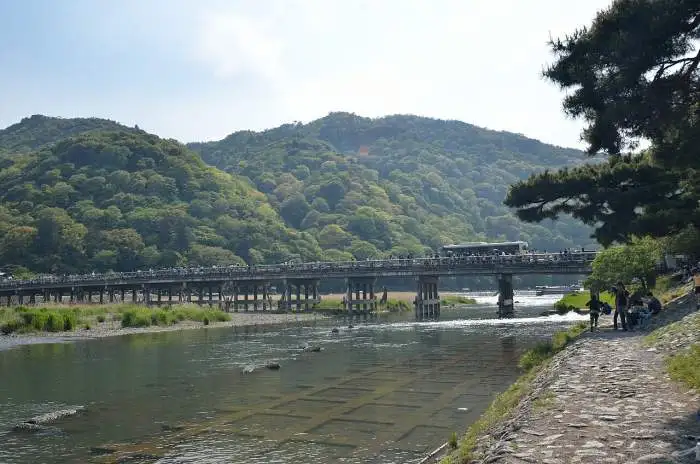
Cross the 155-meter bridge while only the river is making noise. It is concrete, built in 1934 to look like wood.
From Hankyu Arashiyama Station, cross the bridge heading north. - 2Morning
Bamboo Grove Path and Nonomiya Shrine
The 400-meter path runs from Nonomiya Shrine past Tenryu-ji's north gate. The shrine's black-wood torii still has its bark on.
The rustling leaves are best heard early, with few people about. - 3Late morning
Tenryu-ji
Muso Soseki's Sogen-chi Garden borrows Arashiyama as its backdrop. It was the first garden in Japan named a Historic Site and Place of Scenic Beauty.
- 4Afternoon
Sagano Romantic Train and Hozugawa boat
Ride the train about 7 kilometers up the gorge to Kameoka, then take the roughly two-hour boat back down to Arashiyama.
Service is suspended at times. Check each operator first. - 5Golden hour
Oku-Saga
Walk from the thatched hut of Rakushisha to Adashino Nenbutsu-ji, with its about 8,000 stone Buddhas and pagodas.
Once the day-trippers leave, this is easy to reach from a nearby stay. - 6Evening
Togetsukyo Bridge at night
The name means the moon crossing. Stand on the bridge after dark and you catch a little of that feeling.
Only here
Things that surprise first-timers
Stories
Why it looks like this
Togetsukyo Bridge—Named "the Moon Crossing" by Two Different Tellings
The face of Arashiyama, Togetsukyo Bridge (Togetsu-kyo). Spanning the Katsura River (this stretch is also called the Oi River), it is a bridge 155 meters long. The present bridge, rebuilt in 1934 (Showa 9), is made of steel-frame reinforced concrete, yet its design is crafted to look like a wooden bridge—the center raised slightly into a gentle arch, the railings latticed in Japanese cypress (hinoki).
The bridge itself has a long history. By common account, it was first built during the Jowa era (834–848) by the monk Dosho, who revived Horin-ji temple. It was rebuilt at its present location in Keicho 11 (1606), when the wealthy merchant Suminokura Ryoi opened a waterway on the Hozu River.
There are two tellings behind the beautiful name "Togetsukyo." One holds that in the Kamakura period, Emperor Kameyama, watching the moon move across the bridge, remarked that it was "like the flawless moon crossing over." The other holds that Muso Soseki of Tenryu-ji, in selecting the "Ten Scenes of Tenryu-ji," named it "Dogetsu-kyo." Either way, the scene of "the moon crossing" is inscribed in this bridge's name. Standing on the bridge at night, you catch a little of the feeling behind the naming.
The Bamboo Grove Path and Nonomiya Shrine—Passing Through a Scene from The Tale of Genji
Heading north from Togetsukyo Bridge, you reach the Bamboo Grove Path (Chikurin-no-komichi), flanked on both sides by well-tended bamboo. It is a path about 400 meters long, running from Nonomiya Shrine past the north gate of Tenryu-ji to the Okochi Sanso villa. Look up and the sky is cut into thin slivers by the bamboo leaves, and with every passing breeze the leaves rustle all at once. This sound of rustling leaves comes into its own not in the crowded daytime, but in the early morning when few people are about.
Near the entrance to that bamboo grove stands Nonomiya Shrine (Nonomiya-jinja). In ages past, this was the place of purification where the Saio—the princess who served at Ise Grand Shrine on behalf of the emperor—cleansed herself before departing for Ise. It is a pure place, enclosed by a black-wood torii and a low fence of small brushwood.
This shrine is the setting of the "Sakaki" chapter of Murasaki Shikibu's The Tale of Genji, and also the subject of the Noh play "Nonomiya." Its torii is a black-wood torii made of raw sawtooth-oak logs with the bark still on, said to "convey the oldest form of the torii." Today it is also beloved as a shrine of matchmaking, and there is no end to those who stroke the "Okame-ishi" stone to make a wish. It is a place where you can stand, just as it is, within a scene from a thousand-year-old tale.
Tenryu-ji—Born of a Dream of a Golden Dragon, First of Kyoto's Five Great Temples
Spreading out south of the bamboo grove is Tenryu-ji. Formally called Reigizan Tenryu Shiseizenji, it is the head temple of the Tenryu-ji branch of the Rinzai school and a temple of the highest rank, placed first among Kyoto's Five Great Temples (Kyoto Gozan). It was founded by Ashikaga Takauji, who established the Muromachi shogunate, with Muso Soseki as its first abbot (founding priest).
Behind its founding lies the story of Emperor Go-Daigo. To pray for the repose of Emperor Go-Daigo—who had died in Yoshino after his falling-out with Takauji—the former detached palace of Kameyama-dono was converted into a temple; that is Tenryu-ji. It was vowed into being in Ryakuo 2 (1339), and the dedication ceremony was held in Koei 4 (1345). The temple's name "Tenryu" is said to derive from a dream, seen by Takauji's brother Tadayoshi, of a golden dragon dancing over the Oi River. To raise funds for its construction, the shogunate even fitted out a trading ship to Yuan China, the "Tenryu-ji ship."
The highlight is the Sogen-chi Garden (Sogenchi-teien), laid out by Muso Soseki. A celebrated garden of "borrowed scenery" that draws Arashiyama and Mount Kameyama into its backdrop, it is the first garden in Japan to be designated a Historic Site and Place of Scenic Beauty. Tenryu-ji is one of the World Heritage "Historic Monuments of Ancient Kyoto." Gazing at Arashiyama reflected in the pond, you understand at once why people nearly 700 years ago chose that same mountain for their borrowed scenery.
The Hozugawa River Boat Ride and the Sagano Romantic Train—Two Ways Through River and Mountain
The pleasures of Arashiyama are not only in walking the streets. There is the Hozugawa River boat ride, which descends the gorge by boat from Kameoka upstream down to Arashiyama. The boat route was opened by the same Suminokura Ryoi who moved Togetsukyo Bridge to its present position; he opened the waterway in Keicho 11 (1606). Pleasure boats for sightseeing are said to have begun in the Meiji period, and it is a roughly two-hour boat journey in which the boatmen deftly slip between the rocks with pole and oar.
The same gorge can now be enjoyed by rail on the Sagano Romantic Train (Sagano Torokko). A sightseeing railway that opened in 1991, it runs about 7 kilometers along the Hozugawa gorge from Torokko Saga to Torokko Kameoka. It makes use of the old San'in Main Line, left unused after electrification and double-tracking, and the gorge scenery streams past filling the windows.
Take the train up the mountain to Kameoka, then ride the river back down to Arashiyama on the Hozugawa boat—this pairing is the classic. If you stay in Arashiyama, you can cross a quiet Togetsukyo Bridge in the morning and then set out on a full day of river play like this. (There are periods of suspended service, so please check each operator's official information for schedules.)
Oku-Saga—From Rakushisha to Adashino Nenbutsu-ji, a Quiet Mountain Village
Head further north, deep into the Sagano countryside away from the bustle of Togetsukyo Bridge and the bamboo grove, and an astonishingly quiet mountain village opens up. It is the area known as Oku-Saga. At its entrance, set among the fields, stands a small thatched hut, Rakushisha. It was the hermitage of Mukai Kyorai, a disciple of Matsuo Basho, and the name is said to come from an anecdote in which the persimmons (kaki) in the garden nearly all fell in a single night. Basho too stayed here, and in Genroku 4 (1691) he wrote the Saga Diary. It is one of the homelands of haiku.
Small old temples are scattered across this area. Gio-ji is a nunnery connected to The Tale of the Heike. It is a temple with a beautiful moss-covered garden, keeping alive the tale of the tragic love of Gio, a shirabyoshi dancer who was loved by Taira no Kiyomori and then cast aside, and who took Buddhist vows together with her mother and younger sister. The name of Nison-in derives from its enshrinement of the "two revered ones"—Shaka Nyorai and Amida Nyorai—as its principal images, and the approach that continues from the main gate is called the "Maple Avenue." On the mid-slope of Mount Ogura, Jojakko-ji stands with its Important Cultural Property multi-storied pagoda.
At the very deepest point of Oku-Saga is Adashino Nenbutsu-ji. This land was once a place of wind burial and interment; by temple tradition, its origin lies in Kobo Daishi Kukai giving rites to the exposed remains here, and later Honen made it a place of nenbutsu practice. Within the grounds stand about 8,000 stone Buddhas and stone pagodas gathered to console the unmourned dead, a sight called the "Sai-no-kawara." Each year the Sento Kuyo, an offering of lamplight, is held. This area around Mount Ogura is also said to be where Fujiwara no Teika shut himself away in his villa and compiled the Ogura Hyakunin Isshu (the site of Teika's villa is claimed by several temples and is hard to pinpoint; accounts vary). Being able to venture this far into the interior in the evening, once the day-trippers have gone, is the privilege of those who stay nearby.
Matsunoo Taisha and Horin-ji—The God of Sake, and the Jusan-mairi
Turn your eyes from the foot of Togetsukyo Bridge to the mountain skirts on the south side of the river, and on the mid-slope you can see a vermilion multi-storied pagoda. This is Horin-ji. Its principal image is Kokuzo Bosatsu, who grants wisdom, and the temple is known for the "Jusan-mairi," in which children of the counted age of thirteen pray for wisdom and blessings. Widely handed down in Kyoto is the saying that "on your way home from worship, if you look back before you have finished crossing Togetsukyo Bridge, you will give back the wisdom you received" (this is not something official to the temple, but a local folk belief). It lies just a short way in on the mountain side from the south end of Togetsukyo Bridge.
About 1.5 kilometers further south from there, two stops away on the Hankyu line, is Matsunoo Taisha. It was founded in Taiho 1 (701), and by tradition its beginning lies in the Hata clan—an immigrant clan from the continent—welcoming the deity enshrined at the rock formation (iwakura) of Mount Matsuo behind the shrine and building the shrine halls; it is one of Kyoto's foremost ancient shrines. From the medieval period onward it drew the faith of sake brewers throughout the country as "the god of sake" (accounts of how it came to be regarded as the god of sake vary). Within the grounds, sake casks dedicated by breweries from across the land are still stacked in rows. A little apart from the bustle of Togetsukyo Bridge, you can touch the ancient layers of immigration and faith—another dimension of depth to Arashiyama.
Getting around
How to get about
| Togetsukyo Bridge & Bamboo Grove (Ukyo-ku side) | From Hankyu Arashiyama Station, cross Togetsukyo Bridge and head north. The Hankyu station is on the south side of the bridge. |
| Kyoto Station | Transfer at Katsura on the Hankyu line, or take the JR Sagano Line directly from Saga-Arashiyama Station. |
| Kawaramachi & Gion | Direct on the Hankyu Kyoto Line with no transfer, or transfer at Katsura. |
| Osaka (Umeda) | Connect via Katsura and Juso on the Hankyu line, or take a direct service to Osaka-Umeda. |
| Kinkaku-ji & Kitano area | Take the Randen (Keifuku) tram to Kitano-Hakubaicho. |
| Kameoka (Romantic Train & Hozugawa boat ride) | From Saga-Arashiyama Station or Torokko Saga Station. |
Arashiyama has three stations, and because their names are confusingly similar, care is needed. (1) The Hankyu "Arashiyama Station" is on the south side of Togetsukyo Bridge (Nishikyo-ku); (2) the Randen (Keifuku) "Arashiyama Station" and (3) the JR "Saga-Arashiyama Station" are on the north side (Ukyo-ku). Rooms in this area are nearest to Hankyu Arashiyama Station, and you can cross Togetsukyo Bridge to walk to the north side, where the bamboo grove and Tenryu-ji are.
Stay here
Homes in Arashiyama
2 homes in this machi, top rated first. Search with dates →
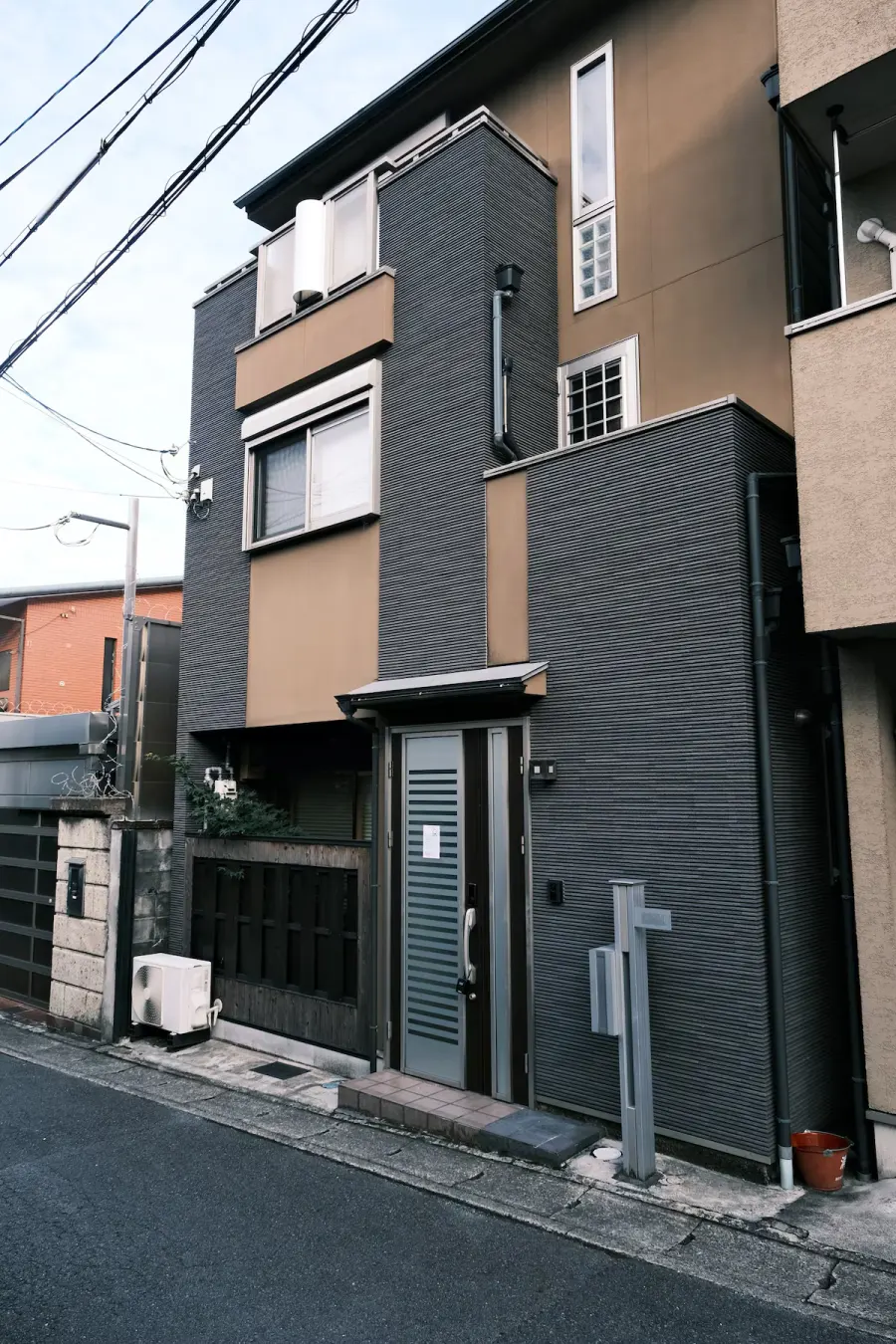 Whole houseSleeps 5
 ApartmentSleeps 4
Stays by station
Questions people ask
Can I walk to Togetsukyo Bridge and the bamboo grove?
Rooms in this area are nearest to Hankyu Arashiyama Station, on the south side of Togetsukyo Bridge. Cross the bridge and walk north and you reach the area with the Bamboo Grove Path and Tenryu-ji. The nearest station and walking time for each room are listed on its own page.
I've heard there are several stations in Arashiyama. Which one is closest?
Arashiyama has three stations—Hankyu, Randen, and JR—with similar names. The nearest for rooms in this area is the Hankyu "Arashiyama Station" (on the south side of Togetsukyo Bridge). We will guide you on the route after you book.
Can I sightsee while avoiding the crowds?
Arashiyama is busy during the day, but it is relatively quiet in the early morning and evening. Staying nearby makes it easier to walk Togetsukyo Bridge and the Bamboo Grove Path during those hours. Please check official information for the visiting hours of each temple and shrine.
Is it easy to get to Kyoto Station?
There are routes via the Sagano Line from JR Saga-Arashiyama Station to Kyoto Station with no transfer, or via a transfer at Katsura on the Hankyu line. We will guide you on the route from your room after you book.
Can I take the Hozugawa River boat ride or the Romantic Train?
Saga-Arashiyama Station and Torokko Saga Station are the starting points. There are periods of suspended service, so please check each operator's official information for the operating status.
How many people can stay?
It varies by room. You can search by narrowing down by number of guests. Arashiyama has whole-house rooms, well suited to stays with family or a group.
Is there a kitchen?
It varies by room. Whole-house rentals include rooms with a kitchen. Please check the facilities on each room's page.
Is it easy to make a day trip to Osaka?
You can head toward Osaka (Umeda) on the Hankyu line. You can relax in Arashiyama while also making a trip out to Osaka.