OSAKA · MACHI GUIDEUmeda & Nakanoshima
In one line
Osaka's big gateway, with a new park and a river island.
Umeda, the gateway to Osaka's "Kita" (north). Whether you arrive by Shinkansen or from the airport, this is where you first set foot. On the north side of Osaka Station, the former site of a freight yard has been reborn as Grand Green Osaka (Umekita), a "city of greenery," and the face of the district is changing dramatically. Just to its south, afloat between the Dojima River and the Tosabori River, lies Nakanoshima—a "cultural island" lined with government offices, a public hall, and museums. From a brand-new, expansive park to a hanging garden atop a high-rise, to the Tenjin Matsuri, one of Japan's three great festivals, this is an area where Osaka's "now" and the "time it has accumulated" live side by side. Because it is a hub of transport, it is easy to move out to anywhere from here.
Character
A day here
Sky garden to river island
Suggested route; check opening days before you go.
- 1Morning
Umekita Park
About 4.5 hectares of lawn and trees sit right behind Osaka Station, on a former freight yard.
Grand Green Osaka keeps opening in stages toward fiscal 2027. - 2Late morning
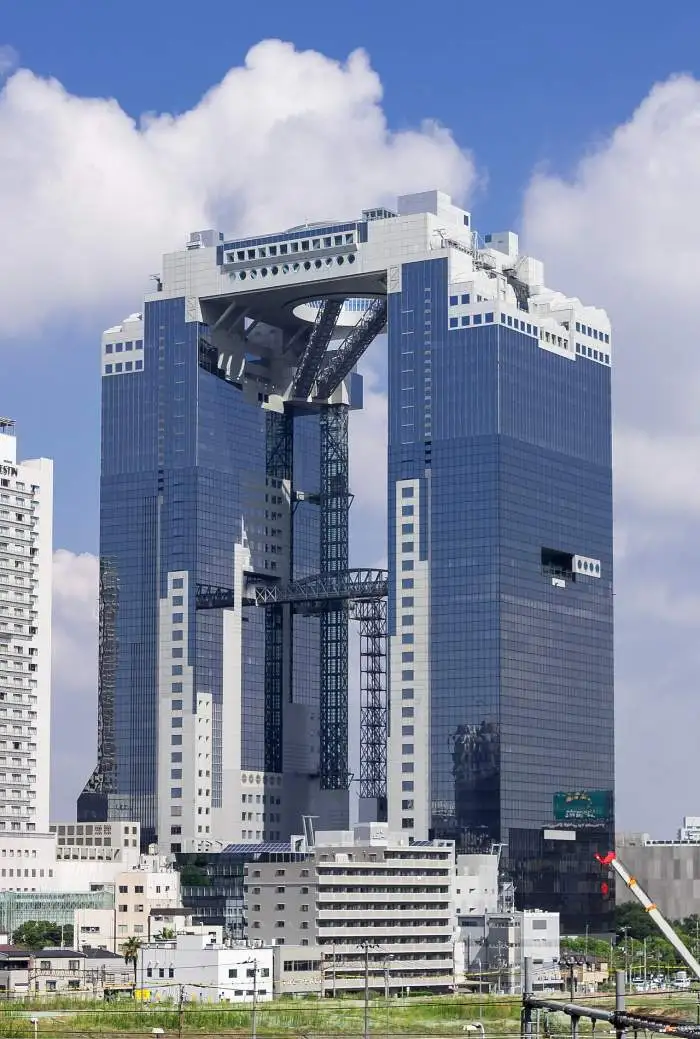
Umeda Sky Building
Two towers joined by a round garden that was built on the ground, then lifted into place. The observation deck is about 170 meters up.
Look for Osaka Bay in the distance. - 3Lunch
Tenjinbashisuji Shopping Street
About 600 shops line a 2.6-kilometer covered arcade that Osakans use every day.
Covered all the way, so rain is no problem. - 4Afternoon
Osaka Tenmangu Shrine
Founded in 949 for Sugawara no Michizane, the god of learning. The present hall dates to 1843.
The shopping street's southern end is right by the shrine. - 5Golden hour
Nakanoshima
See the red-brick Central Public Hall from 1918, the rose garden in Nakanoshima Park, and the fountain at the island's tip.
- 6Evening
HEP FIVE Ferris wheel
The red wheel rises through a building roof to about 106 meters. It was the first in the world built into a building.
Lost in Umeda? Look for the red ring.
Only here
Things that surprise first-timers
Stories
Why it looks like this
Umekita & Grand Green Osaka—A Freight Yard Site Becomes a Station-Connected "City of Greenery"
The north side of Osaka Station is one corner of Japan changing its appearance most dramatically right now. This was once the site of the Umeda Freight Station—a vast JR freight terminal spread across the area. The huge redevelopment project on that site is Umekita (Umekita Phase 2), and on September 6, 2024, its centerpiece, Grand Green Osaka, held its "advance town opening." The full opening will proceed in stages toward fiscal 2027.
The highlight is Umekita Park, spreading across the center of the district. Covering roughly 4.5 hectares north and south combined, it is said to be one of the largest urban parks in the world directly connected to a large-scale terminal station. Right behind Osaka Station, hemmed in by rail lines and high-rises, spreads this much lawn and greenery—the district's concept of "a hub fusing greenery and innovation" becomes the landscape itself.
One step before Umekita, Grand Front Osaka, which opened in 2013, is also a redevelopment of the same freight yard site. A complex gathering shops, restaurants, offices, and a hub for the exchange of knowledge, it is connected to Osaka Station by a covered passage. Walking through this area makes it clear that Umeda is not a "finished town" but one that continues to be renewed even now.
And one more landmark for when you lose your way in Umeda: the red Ferris wheel of HEP FIVE. Rising through the roof of the building to about 106 meters above the ground, this bright-red Ferris wheel is 75 meters in diameter and was the first in the world built integrated into a building. When you spot this red ring in the Umeda sky, that is the center of the district.
Umeda Sky Building—A Garden Assembled on the Ground, Then Hoisted into the Sky
Even among Umeda's cluster of high-rises, the one with a strikingly distinctive form is the Umeda Sky Building. Completed in 1993, it stands 40 stories tall. The tops of its two towers are joined by a circular hanging garden—the world's first connected high-rise building of its kind.
What astonishes is how it was built. The circular garden section that connects the two towers in the sky was first assembled on the ground, then hoisted up whole and set into place at the top—a feat achieved by the "lift-up construction method." Standing on the hanging-garden observation deck about 170 meters above the ground, you see the Umeda cityscape and the Yodo River at your feet, and Osaka Bay in the distance.
This building is also known for having been listed among "the 20 buildings of the world" chosen by Britain's Dorling Kindersley, alongside the Parthenon and the Taj Mahal (a story that "The Times" made the selection has spread, but this is incorrect). Architecture like this stands within walking distance of Osaka Station.
Osaka Tenmangu Shrine and the Tenjin Matsuri—A Summer of Floating Halberds and Boats Going Up the River
East of Umeda, around Minamimorimachi, stands Osaka Tenmangu Shrine. An ancient shrine founded in 949 (Tenryaku 3) by imperial order of Emperor Murakami, its principal deity is Sugawara no Michizane, the god of learning. Because Michizane, on his way to demotion at Dazaifu, worshipped at the Daishogun Shrine that stood on this spot, this shrine was later built here. The present shrine building dates to 1843 (Tenpo 14), rebuilt after a fire caused by the Rebellion of Oshio Heihachiro.
This shrine is known nationwide because of the Tenjin Matsuri. It ranks alongside Kyoto's Gion Matsuri and Tokyo's Kanda Matsuri as one of Japan's three great festivals. Its origins go back to 951 (Tenryaku 5) and the Hoko-nagashi Shinji rite, in which a sacred halberd was set afloat on the Okawa River and a purification was performed where it drifted ashore.
The heart of the festival falls on the eve festival (yomiya) on July 24 and the main festival (hongu) on July 25. On the main day, the procession shifts from the land procession (Riku-togyo), in which a parade bearing the deity winds through the streets, to the river procession (Funa-togyo), in which many boats ply back and forth on the Okawa River, and at night votive fireworks color the water's surface. It is a festival on the water, unique to Osaka, the city of rivers. If you stay in this area, on the night of the main festival you can walk right out to the riverside.
Tenjinbashisuji Shopping Street—A 2.6-Kilometer Straight Road, "Said to Be Japan's Longest"
Heading north from the main approach to Osaka Tenmangu Shrine, the Tenjinbashisuji Shopping Street extends. About 2.6 kilometers long with roughly 600 shops, it is a straight, arcaded road promoted as "Japan's longest shopping street" (that is, "said to be" so).
Its history runs deep: around 1653, at the start of the Edo period, a vegetable market stood in this vicinity, and it flourished as the main approach to Osaka Tenmangu Shrine. Sections are called by abbreviations like "Ten-ichi" and "Ten-san," each with a different character. Rather than a street for tourists, it is a shopping street Osakans use in daily life, and walking from end to end, the everyday life of Osaka flows past just as it is.
The southern end is around Osaka Tenmangu Shrine, and the northern end is Tenjinbashisuji Rokuchome Station on the subway and Hankyu lines. Because it is a covered arcade, you can walk all the way even on a rainy day.
Nakanoshima—A Sandbar Opened by Wealthy Merchants, and Then a Cultural Island
The long, narrow sandbar wedged between the Dojima River and the Tosabori River is Nakanoshima. About 3 kilometers long and at most about 300 meters wide, it was where, at the start of the Edo period, the wealthy merchant Yodoya began developing the sandbar in 1615, and it eventually became the logistics and financial hub of Osaka, the "nation's kitchen," where the warehouse-residences (kurayashiki) of the various domains concentrated.
Today's Nakanoshima is a "cultural island." At its western end, Nakanoshima Park, opened in 1891, was Osaka City's first municipal park and has a rose garden of about 4,000 plants. At the tip called the "Kensaki" (blade point), where the Dojima River and the Tosabori River divide, a fountain rises.
The island's symbol is the red-brick Osaka City Central Public Hall. A Neo-Renaissance building completed in 1918, its construction cost was donated out of private wealth by the stockbroker Iwamoto Einosuke. The design was based on the competition-winning proposal of Okada Shinichiro, with Tatsuno Kingo (the architect behind Tokyo Station) and others handling the working design. It was designated a National Important Cultural Property in 2002. A public building born from a single merchant's donation has remained the face of the island for over a hundred years.
Getting around
How to get about
| Shin-Osaka (Shinkansen) | A few minutes on the JR or Osaka Metro Midosuji Line, no transfer |
| Kansai Airport | Direct from Osaka Station on the JR Kanku Rapid, or the Haruka limited express |
| Itami Airport (Osaka Airport) | Limousine bus from Osaka Station/Umeda, or a monorail connection |
| Namba & Dotonbori | No transfer on the Midosuji Line |
| Kyoto | No transfer on the JR Kyoto Line, Hankyu, or Keihan |
| Kobe & Sannomiya | No transfer on the JR, Hankyu, or Hanshin |
Umeda/Osaka Station is one of western Japan's largest terminals, where JR, private railways, and subways converge. Because you can reach Shin-Osaka for the Shinkansen, as well as Kyoto and Kobe, without transferring, this is the area best suited for a trip using Osaka as a base to travel widely across the Kansai region.
Stay here
Homes in Umeda & Nakanoshima
9 homes in this machi, top rated first. Search with dates →
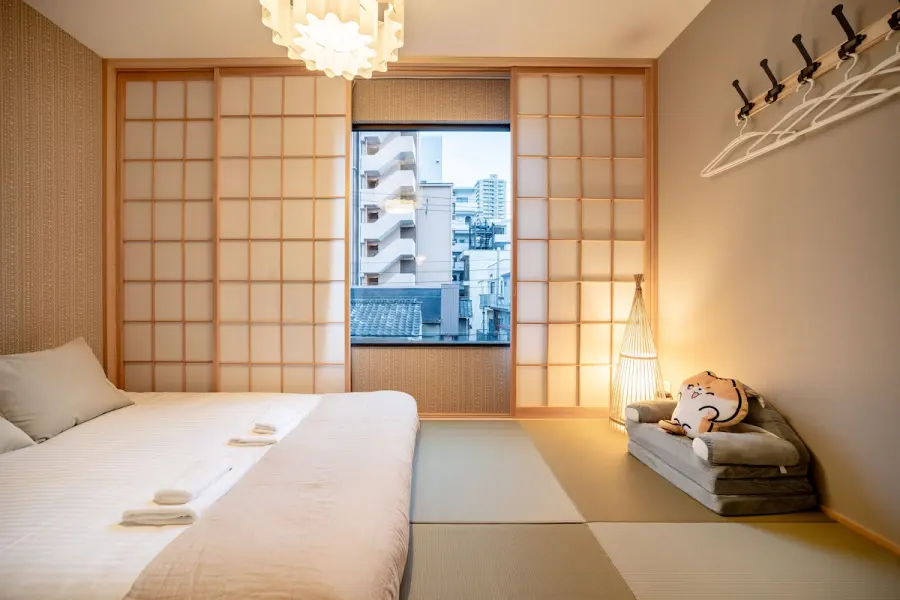 Whole houseGuest favouriteSleeps 10
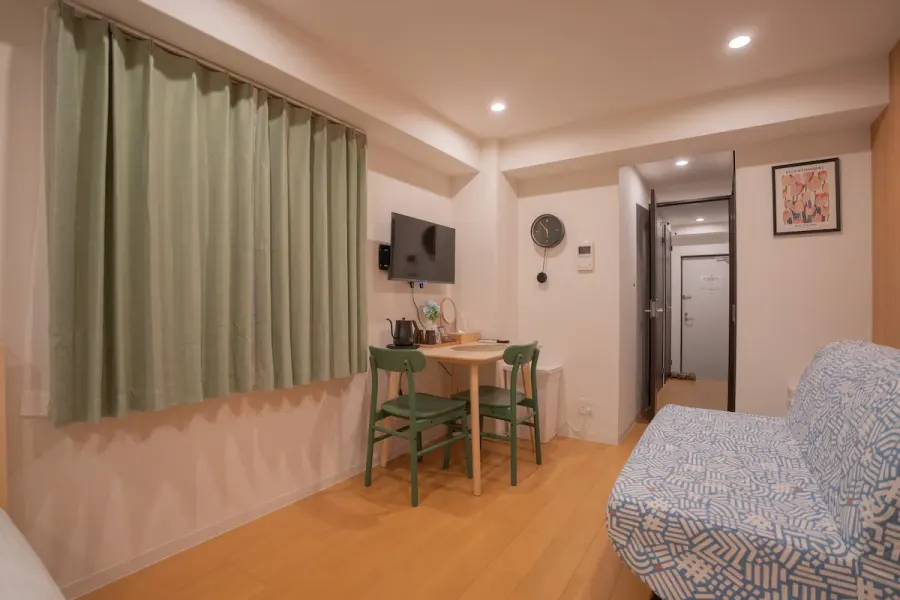 ApartmentGuest favouriteSleeps 3
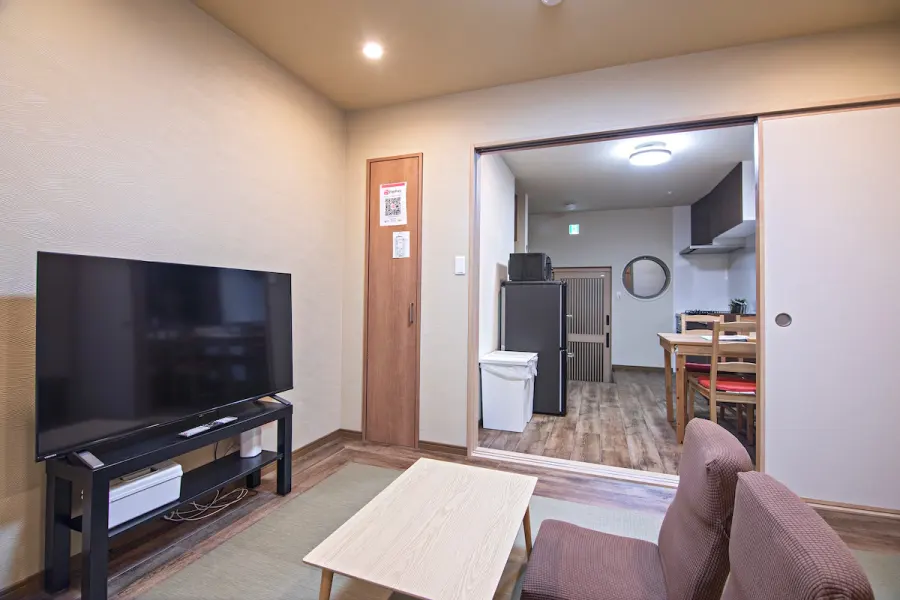 Whole houseSleeps 6
 Whole houseSleeps 8
 Whole houseSleeps 9
 ApartmentGuest favouriteSleeps 2
 Whole houseSleeps 6
 ApartmentSleeps 3
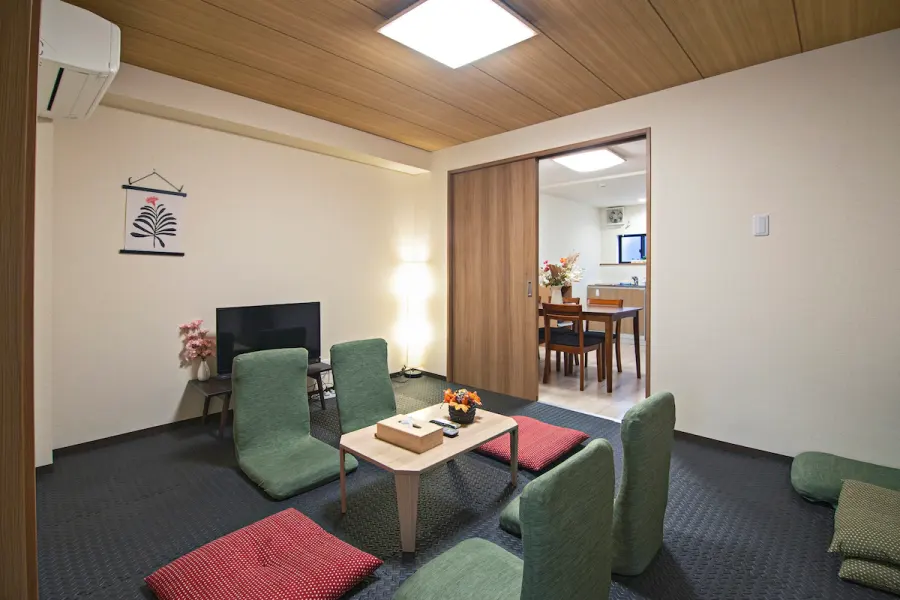 Whole houseSleeps 10
Stays by station
Questions people ask
Is it easy to get to Shin-Osaka Station for the Shinkansen?
It's a few minutes to Shin-Osaka with no transfer on the JR or the Midosuji Line. This area makes an easy base for those entering Osaka by Shinkansen. The nearest station for each room is noted on its page.
Is it close to Grand Green Osaka (Umekita)?
The north side of Osaka Station is Grand Green Osaka (Umekita Phase 2), and Umekita Park, Grand Front Osaka, and HEP FIVE's red Ferris wheel are all within walking distance of Osaka Station/Umeda. It held its advance town opening in 2024, and the opening is proceeding in stages toward fiscal 2027.
Is it easy to take day trips to Kyoto or Kobe?
From Umeda/Osaka Station, you can reach both Kyoto and Kobe without transferring on the JR, Hankyu, Hanshin, or Keihan. It suits use as a base for a trip touring widely across Kansai.
When is the Tenjin Matsuri held?
The eve festival is on July 24 and the main festival on July 25. On the main day, the land procession, river procession, and votive fireworks take place. Please check the official information from Osaka Tenmangu Shrine for details.
How long is the Tenjinbashisuji Shopping Street?
It is about 2.6 kilometers long and is promoted as Japan's longest shopping street. Because it is a covered arcade, you can walk it even on a rainy day. Business hours vary by shop.
Is Umeda easy to walk around even for a first-timer?
Umeda's underground streets are broad and intricate, but they become easier to understand if you use Osaka Station as your starting point. We will guide you on the route to your room after your reservation.
Is it quiet at night?
The center of Umeda has many people even at night, but the Fukushima, Nakanoshima, and Noda sides have a calmer atmosphere. If you want to spend your time quietly, please choose a room on that side.
How many people can stay?
It varies by room. You can search by narrowing down by number of guests. There are also rooms for groups and families.
Is there a kitchen?
It varies by room. Whole-house stays include rooms with a kitchen. Please check the facilities on each room's page.